
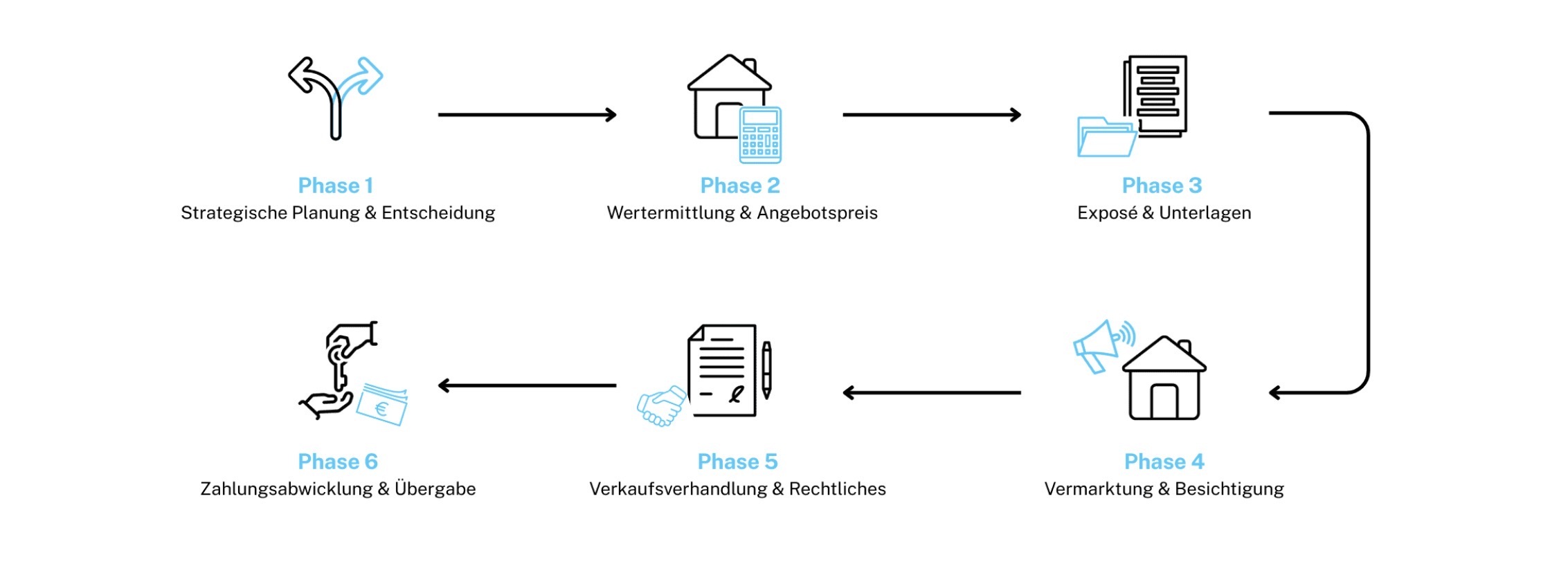
How does the process of selling my property work?
A successful real estate sale begins with a thorough assessment and a clear sales strategy. We personally guide you through the entire process—from the initial consultation, through the closing, to the handover of the keys.
1. Initial Consultation and Property Tour
We discuss your goals, your desired timing for the sale, and the unique features of your property. During a personal tour, we get an accurate picture of the property.
2. Property Valuation and Asking Price
Based on the location, condition, features, and current market conditions, we determine the realistic market value of your property and work with you to establish the appropriate sales strategy.
3. Sales Documentation and Preparation
We prepare the property optimally for sale. This includes, among other things, professional photos, floor plans, sales documentation, and an appealing listing.
4. Marketing
Your property is specifically showcased on relevant real estate portals and other channels. We also directly reach out to potential buyers in our network.
5. Prospective Buyers and Showings
We respond to inquiries, screen prospective buyers, and coordinate showings. This keeps the effort on your part to a minimum.
6. Negotiations and Purchase Offer
We facilitate discussions with potential buyers, conduct price negotiations, and assist you in selecting a suitable buyer.
7. Purchase Agreement and Notarization
Once an agreement is reached, we initiate the necessary steps for the purchase agreement. We coordinate the remaining process with all parties involved and guide you through the process until notarization and closing.
Our goal: You should always know where the sales process stands and what the next steps are—personally, transparently, and professionally.
How long will it take to sell my property?
The time it takes to sell a property depends on the property itself and market conditions. Realistically, the process—from the initial listing to the notary appointment—usually takes between 8 and 24 weeks.
When is the right time to sell?
There is no single “perfect” time to sell a property. Rather, the key factor is the interplay between the current market conditions, the condition and location of the property, and your personal circumstances.
For example, selling may make sense if your life circumstances change, you want to purchase another property, or you want to take advantage of the currently attractive market conditions.
Preparation also plays an important role: A realistic pricing strategy, complete sales documentation, and professional marketing can make a decisive difference in successfully positioning your property on the market.
Are you considering selling your property? We’ll analyze your individual situation and show you which options and timing might be best for selling your property.
What documents do I need to sell my property?
Various documents are required to ensure a smooth real estate sale. The specific documents needed depend, among other things, on the type of property.
Generally, we need:
-
Land registry extract
-
Cadastral map or site plan
-
Construction plans and floor plans
-
Building and living space specifications
-
Building specifications or information on the year of construction
-
Documents regarding renovations and alterations
-
Building insurance policy
-
Energy performance certificate or energy data, if available
-
For condominiums: Bylaws, deed of establishment, minutes of owners’ meetings, and information on the renovation fund
-
For rented properties: Lease agreements and current rent information
-
Information on existing mortgages and easements
Don’t worry if you’re missing a few documents. We’ll work with you to determine which documents are required for the sale and assist you in obtaining them.
The more complete the documentation, the more transparent and efficient the sales process can be.
How will my property be marketed?
Successful marketing begins with a professional presentation and a targeted approach to potential buyers. At Ponimmobilien, each property is positioned individually and marketed using a sales strategy tailored to the specific property. The following services are included in Ponimmobilien’s 1% commission.
Professional marketing includes, among other things:
-
Professional real estate photography for a high-quality presentation of the property
-
Comprehensive sales materials containing the most important information about the property
-
Creation of a professional real estate listing
-
Publication on relevant real estate portals and appropriate digital channels
-
Targeted outreach to pre-registered prospective buyers from our network
-
Personal organization and conduct of property viewings
-
Responding to inquiries and assisting prospective buyers
-
Screening prospective buyers and assessing their financial situation
-
Professional management of price negotiations
Depending on the property, additional measures may be advisable, such as drone photography or videos.
The goal is not to generate as many inquiries as possible, but to reach the right, serious prospective buyers.
Our goal: Your property should be professionally presented, strategically positioned in the market, and successfully sold at a realistic price.
Should I renovate before selling?
Not every renovation is worth doing before selling a property. The key is to determine which measures actually increase the property’s value and appeal, and which costs won’t yield a corresponding return on the sale.
Minor improvements can often be worthwhile—for example, small repairs, a fresh coat of paint, a thorough cleaning, or sprucing up outdoor areas. These can help ensure that the property makes a well-maintained and positive impression during showings.
For larger investments, such as a new kitchen, a new bathroom, or extensive renovations, however, you should carefully assess whether the investment will be reflected in the selling price. Even with older properties, it can make sense to present the existing condition transparently rather than undertaking extensive renovations shortly before the sale.
How are tours organized?
Ponimmobilien handles the organization and coordination of property viewings and schedules appointments with potential buyers and owners.
Before a viewing, prospective buyers are provided with as much detailed information as possible about the property. For serious prospective buyers, it is also possible to determine early on whether the purchase is financially feasible in principle.
Viewings are conducted in person and tailored to the specific property. This gives prospective buyers the opportunity to ask questions about the property and gain a comprehensive impression of it.
After the viewings, we stay in contact with prospective buyers, answer any remaining questions, and clarify the next steps.
For occupied properties, we take special care to organize viewings discreetly and as smoothly as possible. Appointments are coordinated with the residents or owners, and viewings are consolidated whenever possible.
Our goal: To minimize the effort required of you as the owner, while ensuring that serious prospective buyers receive professional support and are guided through the sales process.
How are prospective buyers screened?
When selling a property, it’s not just the amount of an offer that matters. It’s also important to determine whether the prospective buyer can actually finance the purchase price and meets the requirements for a successful transaction.
Ponimmobilien therefore clarifies the following points in particular—to the extent possible—during the sales process:
-
The prospective buyer’s interest in purchasing and motivation
-
Financial capacity and down payment
-
Confirmation of financing or financing assessment from the bank
-
Amount and terms of any purchase offer
-
Desired closing or handover date
-
Special conditions or reservations on the part of the prospective buyer
In the event of a concrete purchase offer, we can request the necessary financing documents or a corresponding confirmation from the bank. This helps reduce the risk that a sale will later fall through due to unsecured financing.
For investment properties, additional factors such as rental income, yield, existing leases, and the planned financing are also taken into account.
Our goal: We aim to provide our clients with the most well-informed basis for decision-making possible, while simultaneously guiding serious prospective buyers professionally and fairly through the sales process.
The final review and approval of the financing are carried out by the respective financial institution.
Who conducts price negotiations with prospective buyers?
When a property is sold through Ponimmobilien, we conduct the price negotiations directly and provide personal support throughout the process. In doing so, we represent our clients’ interests while maintaining close contact with prospective buyers.
We do not evaluate incoming purchase offers based solely on the price offered. Factors such as the buyer’s ability to secure financing, solvency, desired closing date, terms of the offer, and other points relevant to the sale may also play a role.
If there are multiple interested buyers, we coordinate the offers and provide the property owner with as transparent a basis for decision-making as possible. Together, we discuss the respective offers and the next steps.
The final decision on whether to accept or reject a purchase offer naturally rests with the owner.
Our goal is to conduct negotiations professionally, objectively, and in a goal-oriented manner, thereby laying a solid foundation for a successful closing.
What happens after the purchase is approved?
Once the purchase has been agreed upon, preparations for the actual real estate purchase begin. The next steps are coordinated among the buyer, the seller, the bank, and the notary’s office.
First, the key details of the sale are confirmed, and the financing and agreed-upon terms are reviewed once again. The necessary documents for the purchase agreement are then compiled and submitted to the responsible notary’s office.
The notary’s office drafts the purchase agreement and coordinates the public notarization. Depending on the situation, a reservation agreement or a corresponding written agreement may also be concluded prior to notarization.
After the purchase agreement is signed, the remaining steps leading up to the transfer of ownership and the agreed-upon handover of the property are organized. These include, among other things, processing the payment, coordinating with the financing bank, and handing over the keys.
Ponimmobilien continues to support buyers and sellers even after the purchase agreement has been accepted and remains available as a point of contact for coordinating the next steps.
What documents are required for the notary?
For the public notarization of a real estate sale, the notary’s office requires various documents and information from the buyer and seller. The specific documents required depend on the canton, the property, and the personal circumstances of the parties.
As a general rule, the following are required in particular:
-
Proof of identity, such as a passport or ID card, as well as an AHV number
-
Complete personal information and contact details of the contracting parties
-
Details regarding the property and ownership status
-
A current land registry extract or the necessary land registry details
-
Information regarding existing real estate liens and mortgage notes
-
If applicable, powers of attorney or documents evidencing the right to represent
-
For married individuals or in cases of special ownership arrangements, additional consents or supporting documentation, if applicable
-
For legal entities, the relevant company and representation details
-
For special properties, additional permits or documents—for example, regarding building rights, agricultural land, or certain easements
The notary’s office reviews the information required for notarization and drafts the purchase agreement. In Basel-Landschaft, for example, the parties’ personal details and the necessary proof of identity for land registry registration must be provided.
Ponimmobilien assists sellers in compiling the documents required for the sale and coordinates the transaction with the buyer, the bank, the notary’s office, and the land registry. The specific documents required for each case are clarified with the responsible notary’s office prior to notarization.
What happens during a public notarization?
Public notarization is an important step in the sale of a property. During this process, the purchase agreement is notarized by the relevant notary’s office. The buyer and seller confirm with their signatures that they agree to the contract and the terms set forth therein.
The purchase agreement sets forth, among other things, the purchase price, the parties to the agreement, the property being sold, the closing date, and other terms related to the sale. The notary’s office reviews the necessary documents and ensures that the agreement complies with legal and formal requirements.
Following notarization, the subsequent steps for payment processing, transfer of ownership, and handover of the property take place as agreed.
Ponimmobilien coordinates the process with the buyer, seller, financing bank, and notary’s office and supports the property owner through this important step as well. The legal review and notarization of the purchase agreement are carried out by the responsible notary’s office.
When does ownership transfer to the buyer?
Ownership of a property generally transfers to the buyer upon the buyer’s registration in the land register. Simply signing the notarized purchase agreement does not, in and of itself, make the buyer the owner. For a real estate purchase, both the notarized purchase agreement and the entry in the land registry are generally required.
The purchase agreement sets forth, among other things, the purchase price, the closing date, and other agreements between the buyer and seller. After notarization, the transaction is filed with the relevant land registry office. As soon as the requirements are met and the entry is made, the buyer is listed as the new owner in the land registry.
The transfer of possession and rights and obligations can be contractually set for a specific date and does not necessarily have to coincide with the date of registration in the land registry. Therefore, the provisions in the purchase agreement are decisive.
Ponimmobilien coordinates the sales process between the seller, buyer, financing banks, and the notary’s office, and provides support with the organizational aspects of the transaction through to the agreed-upon closing.
The legal transfer of ownership is governed by statutory provisions and the entry in the relevant land registry.
When will the keys be handed over?
The keys are typically handed over on the date agreed upon in the purchase agreement. This date may, for example, coincide with the date of transfer of ownership or another date agreed upon between the buyer and the seller.
Before the handover, all key points should be clarified, particularly the full payment of the purchase price and the conditions for the handover as agreed in the purchase agreement. During the key handover, the property is usually inspected together, and its condition, as well as the existing keys, remote controls, and other means of access, can be documented. Depending on the property, meter readings may also be taken.
At Ponimmobilien, we coordinate the key handover between the buyer and seller and assist with the organizational aspects of the process. This may also include documenting meter readings and handing over relevant documents.
The agreements set forth in the notarized purchase contract are always binding. Therefore, in the case of special handover arrangements, clear terms should be established well in advance.